
-
Our Businesses

- Sustainability
- Our Blogs
-
Careers
- About Us
- Contact Us


For decades, industrial automation was often associated with large robotic systems operating behind safety barriers, performing repetitive tasks with minimal human interaction. Today, that perception is changing rapidly. The rise of collaborative robots (cobots) and Artificial Intelligence (AI) is creating a new paradigm where humans and machines work side by side, combining their respective strengths to achieve unprecedented levels of productivity, flexibility, and efficiency.
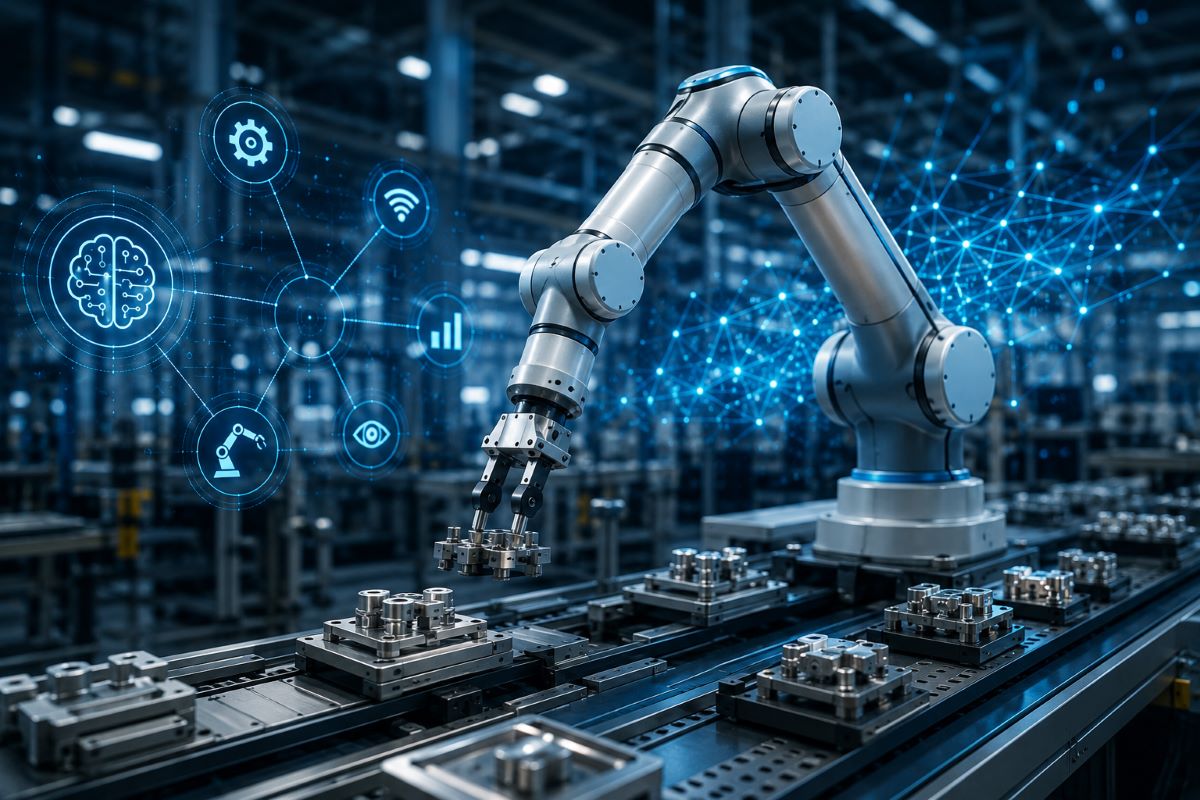
As India's manufacturing sector accelerates its journey toward Industry 4.0, human-machine collaboration is emerging as a critical driver of competitiveness. Rather than replacing workers, cobots and AI are empowering them, enabling smarter decision-making, safer workplaces, and more agile production environments.
Unlike traditional industrial robots that operate in isolated work cells, collaborative robots are specifically designed to interact safely with human operators. Equipped with advanced sensors, force-limiting technology, and intelligent control systems, cobots can work alongside employees without requiring extensive safety fencing.
Cobots are particularly valuable for tasks such as:
• Assembly operations
• Material handling
• Packaging and palletizing
• Quality inspection
• Machine tending
• Pick-and-place applications
Their ease of deployment, flexibility, and lower implementation costs make them attractive to both large manufacturers and small-to-medium enterprises (SMEs) across India.
While cobots provide the physical capabilities, AI serves as the intelligence layer that enhances decision-making and operational efficiency.
AI-powered systems can:
• Analyze production data in real time
• Predict equipment failures before they occur
• Optimize production schedules
• Improve quality control through machine vision
• Enable adaptive manufacturing processes
By continuously learning from operational data, AI helps manufacturers move from reactive to proactive operations, reducing downtime and improving overall equipment effectiveness (OEE).
The true value of automation lies not in replacing human expertise but in augmenting it.
Humans excel at problem-solving, creativity, judgment, and adapting to unexpected situations. Machines excel at precision, consistency, speed, and handling repetitive tasks. When combined, they create a highly efficient and resilient workforce.
For example, a cobot can perform repetitive assembly tasks while a skilled operator focuses on quality verification, process optimization, and exception handling. AI systems can provide real-time insights, enabling workers to make informed decisions faster and with greater confidence.
This collaborative approach helps manufacturers achieve:
• Higher productivity
• Improved product quality
• Enhanced worker safety
• Reduced operational costs
• Greater manufacturing flexibility
India's manufacturing landscape is uniquely positioned to benefit from collaborative automation.
Several factors are driving adoption:
Rising Demand for Productivity
As manufacturers face increasing global competition, there is growing pressure to improve throughput, reduce waste, and maintain consistent quality standards.
Workforce Empowerment
Cobots help address labor shortages while allowing skilled workers to focus on higher-value tasks rather than repetitive manual operations.
Growing Industry 4.0 Adoption
Indian manufacturers are increasingly investing in digital transformation initiatives, including smart factories, connected devices, Industrial IoT (IIoT), and AI-driven analytics.
Accessibility for SMEs
Unlike traditional automation systems that often require significant capital investment, cobots offer a more accessible entry point for small and medium-sized manufacturers looking to modernize operations.
Human-machine collaboration is already transforming multiple sectors across India:
Automotive Manufacturing
Cobots assist with assembly, welding support, and component handling while AI optimizes production workflows and quality control processes.
Electronics Manufacturing
Precision assembly tasks benefit from cobot accuracy, while AI-powered inspection systems identify defects with remarkable consistency.
Food and Beverage
Collaborative robots support packaging and palletizing operations while AI improves demand forecasting and production planning.
Pharmaceuticals
AI-enabled quality monitoring combined with cobot-assisted handling ensures greater accuracy, compliance, and efficiency.
The factory of the future will not be defined solely by advanced robotics or artificial intelligence. Instead, it will be characterized by seamless collaboration between people, machines, and data.
Successful manufacturers will embrace technologies that enhance workforce capabilities rather than simply automate processes. By integrating cobots, AI, and connected automation systems, organizations can create smarter, safer, and more productive manufacturing environments.
The convergence of cobots and AI is reshaping the future of industrial automation in India. As businesses navigate increasing demands for efficiency, quality, and flexibility, human-machine collaboration offers a practical and scalable path forward.
Rather than viewing automation as a replacement for human workers, manufacturers should see it as an opportunity to unlock new levels of innovation and performance. By orchestrating the strengths of people, collaborative robots, and artificial intelligence, Indian industries can build resilient operations that are ready for the challenges and opportunities of tomorrow.
The future of automation is not human versus machine—it is human and machine working together.
We are always open to cooperation
and welcome new projects