
-
Our Businesses

- Sustainability
- Our Blogs
-
Careers
- About Us
- Contact Us


With rising labor costs, increasing competition, and demand for higher quality production, Indian industries are adopting automation systems to increase productivity and reduce operational risk.
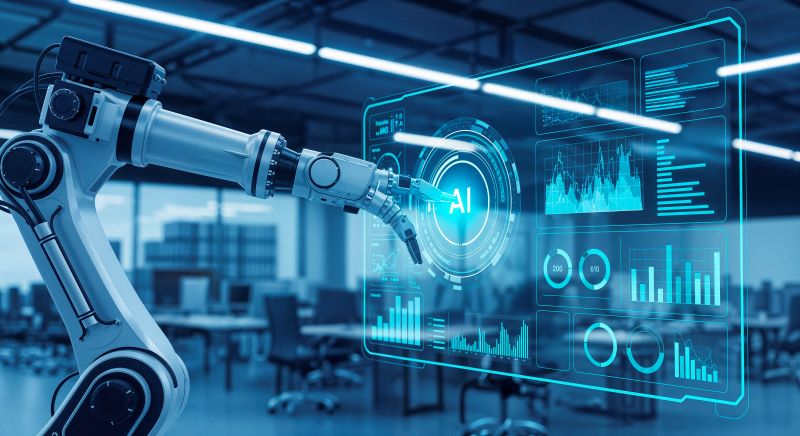
From AI-powered maintenance to robotics and smart factory networks, 2026 is the year where manufacturing becomes truly data-driven.
Cobots are one of the fastest-growing automation trends in 2026.
Unlike traditional robots that require isolated safety zones, cobots are designed to work alongside humans safely. They are being used for:
• Assembly lines
• Packaging
• Material handling
• Quality inspection
• Welding and repetitive production tasks
Their flexibility makes them ideal for SMEs and mid-sized factories. Cobots reduce human fatigue and improve accuracy, while still allowing human supervision.
In 2026, cobots are becoming a cost-effective alternative to full robotic systems.
Factories lose massive revenue due to unexpected machine breakdowns. In 2026, predictive maintenance is becoming a standard requirement.
Sensors installed on machines collect real-time data such as:
• Vibration levels
• Motor temperature
• Noise changes
• Pressure variations
• Power consumption patterns
AI systems analyze this data and predict failures before they happen. This allows manufacturers to repair machines before downtime occurs.
• Heavy manufacturing
• Electrical motor-driven industries
• Pump-based processing plants
• HVAC industrial systems
In 2026, predictive maintenance is not only improving efficiency but also increasing machine lifespan.
Digital twin technology creates a virtual replica of a physical machine or entire production line.
• Test new workflows
• Detect bottlenecks
• Simulate load conditions
• Predict energy usage
• Improve layout planning without risk
This reduces trial-and-error costs in real factories. It also speeds up decision-making because improvements can be validated digitally before implementation.
Digital twins are becoming popular in automotive, packaging, and electronics manufacturing.
In traditional automation setups, data is sent to a central cloud server for analysis. That creates delays.
• Faster response time
• Better quality control
• Instant safety alerts
• Reduced cloud dependency
Edge computing is critical in factories where seconds matter, especially in robotic lines and high-speed production.
With 5G adoption increasing, smart factories are becoming more connected. 5G enables:
• Faster communication between machines
• Real-time monitoring across large plants
• Remote machine control
• Automated guided vehicles (AGVs) navigation
In 2026, 5G is powering automation environments where thousands of connected devices operate together without lag.
Industrial automation in 2026 is driven by robotics, AI, and real-time connectivity. Indian manufacturers adopting these trends will reduce downtime, improve quality, and compete at global standards.
Automation is no longer optional—it is becoming a necessity for future manufacturing success.
We are always open to cooperation
and welcome new projects